Last revised: February 2026 v1.3
Altered Group Structure and Site Use in Bornean Bristlehead Following Playback Disturbance: Evidence from Long-Term Citizen Science Observations
Dixon Lau (Independent Citizen Scientist, Sarawak, Malaysian Borneo)
Date: 22 January 2026
Abstract
Long-term opportunistic observations of Bornean Bristlehead (Pityriasis gymnocephala) in a lowland peat swamp forest in Sarawak, Malaysia, documented stable group presence and predictable detection patterns over more than two years (June 2023–September 2025). Following a playback disturbance incident in September 2025, sightings declined markedly and were dominated by solitary individuals or pairs, representing a departure from prior group cohesion. Comparative analysis of equivalent visiting-week periods showed a decline in sighting rate from 19.7% prior to disturbance to 10.8% afterward, despite similar observation effort. A solitary individual observed in January 2026 exhibited prolonged vocalisation and ranging behaviour, suggesting possible disruption of social cohesion. Subsequent observations in February 2026 recorded groups of three to four individuals, indicating partial recovery. These observations suggest that playback disturbance may temporarily disrupt social structure and site use in this highly social species and highlight the importance of cautious playback use and long-term behavioural monitoring.
Introduction
The Bornean Bristlehead Pityriasis gymnocephala is a scarce endemic species of Borneo, typically occurring in small social groups of 5–12 individuals (Smythies 1999; Phillipps & Phillipps 2014). These groups maintain close cohesion during foraging and movement, reflecting the species’ strongly social organisation (Fig. 1). Cooperative behaviours, including food transfer between individuals, further illustrate the complexity of social interactions in this species (Fig. 2).
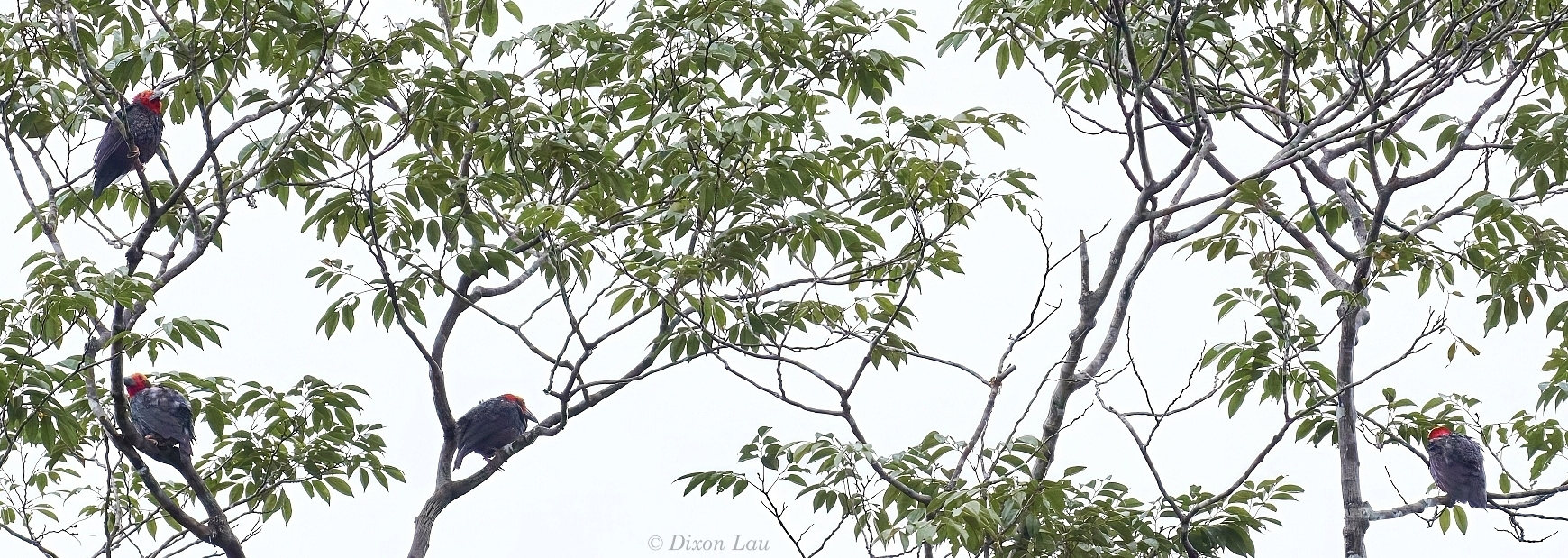
Figure 1. Group of four Bornean Bristleheads Pityriasis gymnocephala perched together in lowland peat swamp forest, Sarawak, Malaysia. This species typically occurs in cohesive social groups. Photo by D. Lau, Aug 2024.
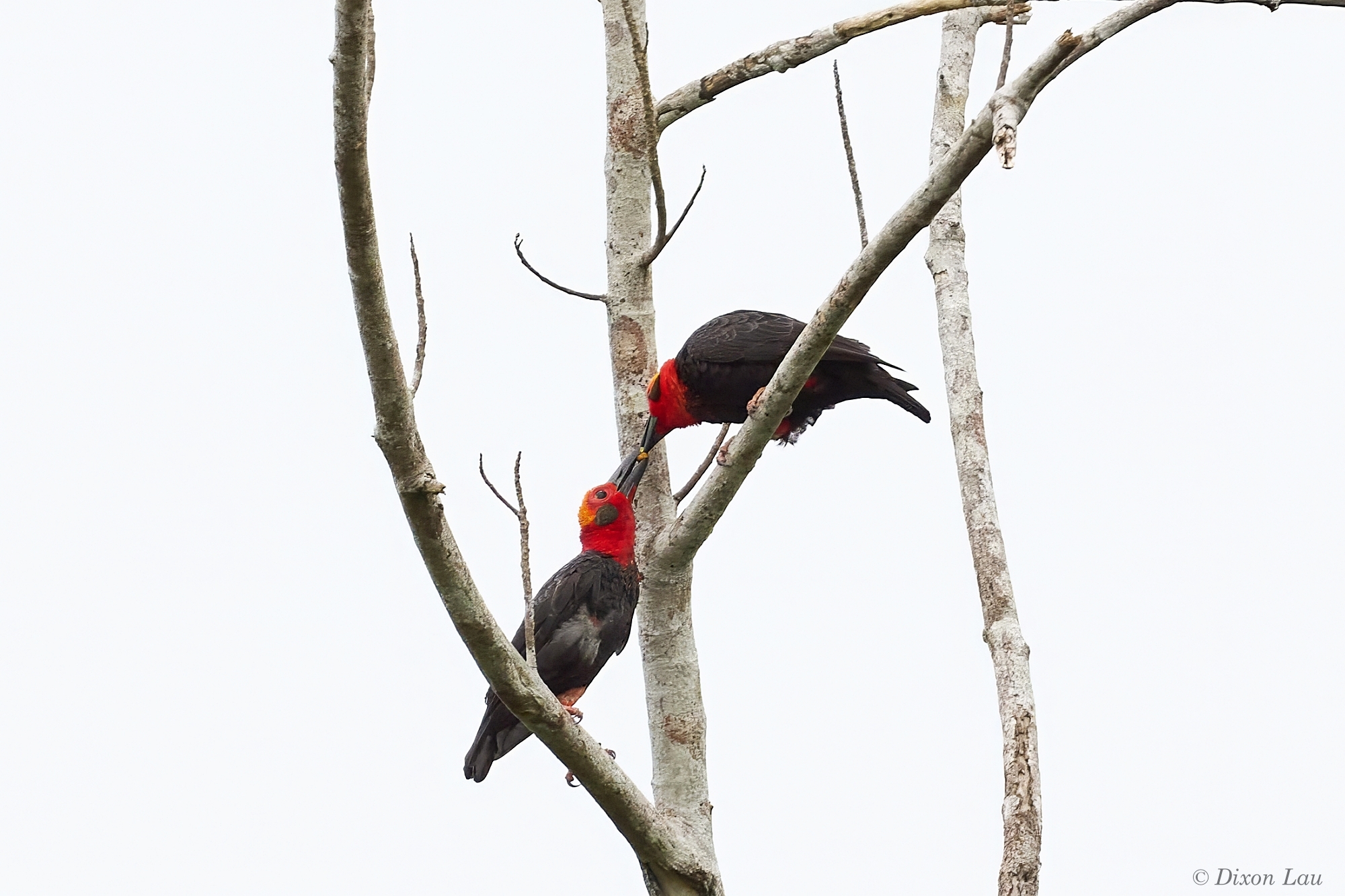
Figure 2. Two Bornean Bristleheads Pityriasis gymnocephala, with one individual passing a fig to another, illustrating cooperative social behaviour within the group. Photo by D. Lau, May 2025.
Despite their distinctive social behaviour, responses to disturbance remain poorly documented. Playback of vocalisations is commonly used in field studies and birdwatching, but inappropriate use may disrupt social cohesion in highly vocal species. This paper presents long-term opportunistic observations of a resident Bristlehead group in a lowland peat swamp forest in Sarawak, Malaysia, and documents changes in detection frequency, group size, and social behaviour following a playback disturbance incident.
Methods
Observations were conducted opportunistically between June 2023 and February 2026 within an approximately 3 km radius lowland peat swamp forest. Records consisted primarily of visual detections supported by photographic documentation during regular forest visits. Auditory detections without visual confirmation were not included in the formal record. Multiple sightings of the same individuals within short time periods, including within the same day, were treated as single records to avoid duplication. The observer is an independent citizen scientist without formal academic training in wildlife biology and did not use playback at any time.
Results
Between June 2023 and February 2026, a total of 55 visually confirmed records of Bornean Bristlehead were obtained at the study site.
Before the disturbance incident, Bristleheads were regularly detected at the study site, typically in groups of multiple individuals. Long-duration solitary individuals were not observed; single birds were only briefly seen and were usually associated with calls from nearby conspecifics, indicating the presence of additional individuals in the vicinity.
To quantify changes in detection frequency, visits were standardized by the number of visiting weeks in which monitoring occurred. During the 19 visiting weeks prior to disturbance (20 January–13 September 2025), a total of 76 visits yielded 15 sightings, corresponding to a sighting rate of 19.7%, with an average of 4.0 visits per week. In the 19 visiting weeks following disturbance (14 September 2025–6 February 2026), 83 visits yielded 9 sightings, corresponding to a reduced sighting rate of 10.8%, with an average of 4.4 visits per week (Fig. 3).
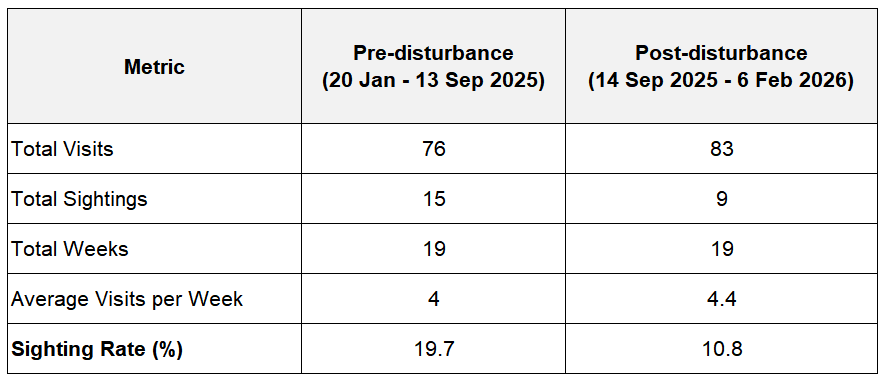
Figure 3. Comparison of Bornean Bristlehead detection before and after the disturbance, standardized by 19 visiting weeks per period. Sighting rate declined from 19.7% (15 sightings, 76 visits) prior to disturbance to 10.8% (9 sightings, 83 visits) following disturbance, despite similar observation effort.
Following the disturbance event, a sighting was recorded shortly thereafter, followed by a gap of nearly five weeks (18 September–20 October 2025) without detections, despite repeated visits across this period. Subsequent records resumed gradually, initially at longer intervals and later approaching pre-disturbance detection frequency, although group size remained reduced. Occasional vocalisations were heard at distance during this period but were not included in the formal record due to lack of visual confirmation. Observations at forest-edge locations also became less frequent compared with the baseline period.
During an observation in January 2026, a single individual was recorded moving repeatedly within an area of approximately 600–800 m radius while vocalising persistently for over one hour (Fig. 4).
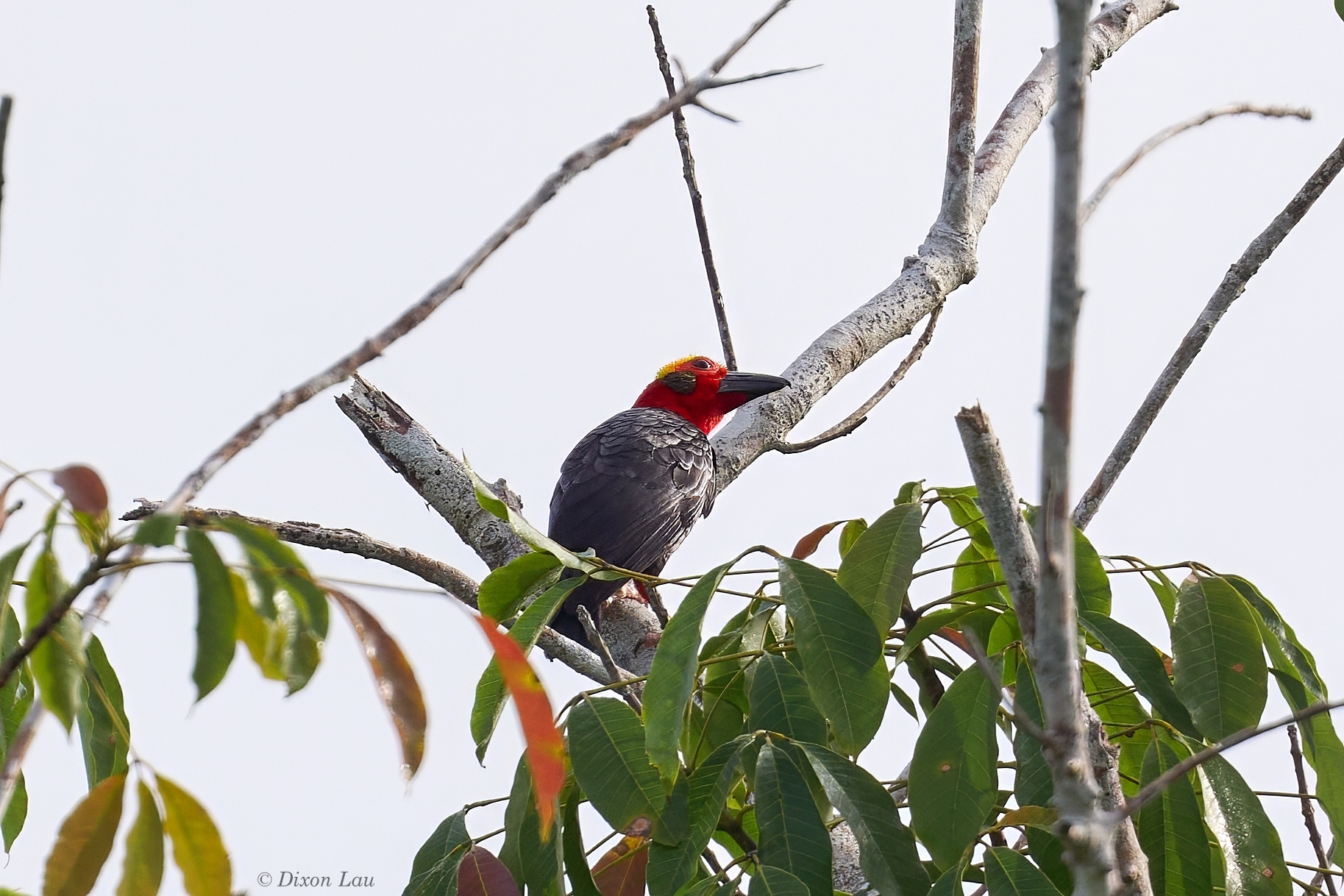
Figure 4. Solitary Bornean Bristlehead Pityriasis gymnocephala, vocalising and moving within a restricted area for an extended period. Photo by D. Lau, Jan 2026.
Subsequent observations in February 2026 documented four individuals together on 7 February and 9 February, representing the first record of more than two individuals in a single group since the disturbance incident several months earlier. During these observations, individuals followed one another closely, vocalisations were soft, and stops were brief.
On 9 February, all four individuals perched in close proximity within a single tree. Only one individual was observed feeding, while the remaining birds remained alert and stationary. The prey item appeared to be the protective case of a caterpillar, possibly a bagworm. After feeding, the group departed together in close succession.
Approximately one week later, three individuals were recorded. Calls were louder and more frequent compared to earlier post-disturbance observations. Individuals were spaced approximately 50–100 m apart and were also observed perching openly, including on exposed branches. Observation duration was limited to approximately five minutes to minimise disturbance, and vocalisations remained audible up to approximately 400 m after departure from the site.
Discussion
The observed decline in detection frequency following the September 2025 disturbance suggests a measurable behavioural response by the Bristlehead group. When standardized to 19 visiting weeks per period, sighting rate decreased from 19.7% prior to disturbance to 10.8% afterward, despite comparable observation effort. This reduction likely reflects decreased visibility rather than absence, as individuals were still intermittently detected within the same general area. Such patterns are consistent with increased wariness, altered movement patterns, or shifts toward denser vegetation, all of which would reduce detectability without necessarily indicating site abandonment.
The abrupt departure from established detection patterns, including reduced group size and solitary vocal behaviour, suggests temporary disruption of social cohesion rather than natural population fluctuation. The prolonged vocalisation by the solitary individual observed in January 2026 may reflect attempts to maintain acoustic contact or re-establish social cohesion, behaviours not recorded during the baseline period. Given the species’ strong reliance on coordinated group movement and communication, such behaviour likely reflects disruption to normal social structure.
Subsequent observations in February 2026 documented groups of three to four individuals, representing the first confirmed multi-individual records since the disturbance. Individuals displayed louder and more frequent vocalisations, increased spacing between group members (approximately 50–100 m), and more open perching. These changes may indicate gradual behavioural recovery, although the limited number of observations prevents definitive conclusions. The persistence of altered spacing and vocal behaviour suggests that full restoration of normal group cohesion may require extended time.
Playback disturbance represents a plausible contributing factor to this behavioural shift. Bornean Bristleheads are highly social and vocal birds that rely on acoustic communication for group cohesion, coordination, and possibly territory maintenance. Artificial playback may therefore introduce misleading or conflicting social cues, potentially disrupting movement, vigilance, or communication patterns. Even brief or contextually inappropriate playback may be perceived as an intrusion or abnormal signal, eliciting caution or avoidance responses (Curé et al., 2013; Slabbekoorn & Peet, 2003).
In 2024, an incident was observed in which an individual replayed a brief (~1 s) segment of live vocalisations recorded on-site from Bristleheads present at the time, apparently outside a research or monitoring context. The birds had been foraging normally prior to playback, but the entire group of 5–6 individuals responded immediately with loud vocalisations and erratic movements, indicating marked agitation and confusion. The sudden, contextually incongruent playback likely constituted an abnormal social cue that disrupted ongoing behaviour. Although the group settled after several minutes, they subsequently withdrew into denser forest cover. This observation demonstrates that even very brief or partial playback, when applied inappropriately, can elicit strong behavioural responses and underscores the need for caution in the use of acoustic playback in the field (Curé et al., 2013; Slabbekoorn & Peet, 2003).
Taken together with the observed playback-induced behavioural response in 2024, the multi-year continuity of records demonstrates that Bristleheads maintained consistent site use despite episodic disturbances. These findings underscore the value of long-term monitoring to detect subtle behavioural changes that are not apparent from simple presence–absence data (Dickinson et al., 2010). Multi-site or multi-observer studies would be valuable to determine whether similar patterns occur elsewhere and to further evaluate the long-term impacts of playback on this highly social species.
Conclusion
This case highlights the potential for playback to cause sustained changes in group structure and site use in Bornean Bristlehead and underscores the value of long-term citizen science observations in detecting behavioural impacts not evident from presence absence data alone.
About the Author
Dixon Lau is an independent citizen scientist based in Sarawak, Malaysian Borneo, with a strong interest in wildlife behaviour, documentation, and long-term field observations. Since 2020, he has recorded more than 59 visual observations of Bornean Bristlehead (Pityriasis gymnocephala) in Sarawak alone, across various habitats including mature secondary lowland forest, mangrove forest, and lowland peat swamp forest. In the study location, extensive observations were made possible by the species’ consistent presence and the site’s accessibility.
Since 2024, Dixon has adopted a more systematic and intensive approach to observation and documentation, with more frequent site visits and extended time spent in the field. As a result, his field experience and understanding of the species have deepened substantially. While not formally trained in academic wildlife research, he applies rigorous observation protocols, careful documentation, and consistent field monitoring to contribute valuable behavioural data and insights for conservation and public awareness.
Limitations and Disclaimer
The observations presented here were made opportunistically by an independent citizen scientist and do not constitute formal research or a controlled experimental study.
Detection frequency and group size may be influenced by environmental conditions, observer availability, seasonal variation, and natural movement patterns.
All observations were incidental, and no playback or manipulation was used by the observer.
Interpretations regarding potential behavioural impacts of playback by a certain party are descriptive and cannot be considered definitive evidence of causation.
While care has been taken to accurately document sightings and behaviours, limitations inherent to field observation, including observer bias and limited visibility, may affect data completeness.
These notes are intended to provide insight into Bornean Bristlehead behaviour and serve as a reference for future monitoring, but they should be interpreted with caution.
Acknowledgements
I thank Dato' Dr Amar-Singh HSS for reviewing and providing valuable feedback on the manuscript.
References
- Smythies, B.E. (1999). The Birds of Borneo. Fourth edition. Revised by Davison, G.W.H. Natural History Publications (Borneo), Kota Kinabalu.
- Phillipps, Q. & Phillipps, K. (2014). Phillipps' Field Guide to the Birds of Borneo: Sabah, Sarawak, Brunei and Kalimantan. Third edition. John Beaufoy Publishing, UK.
- Curé, J., Boulinier, T., & Jiguet, F. (2013). Playback experiments and behavioural responses in forest birds: implications for conservation. Journal of Ornithology, 154, 37–47.
- Slabbekoorn, H. & Peet, M. (2003). Birds sing at a higher pitch in urban noise. Nature, 424, 267.
- Dickinson, J.L., Zuckerberg, B., & Bonter, D.N. (2010). Citizen science as an ecological research tool: challenges and benefits. Annual Review of Ecology, Evolution, and Systematics, 41, 149–172.
Citation
Lau, D. (2026). Altered Group Structure and Site Use in Bornean Bristlehead Following Playback Disturbance: Evidence from Long-Term Citizen Science Observations. Short Communication. Sarawak, Malaysia.